Pages

Showing posts with label green tea. Show all posts

Friday, November 15, 2013

Ezaki Glico Baiton d'or (luxury version of Pocky)

A few days late, but Happy Pocky Day... (11/11) Yes, in Japan, there is a Pocky Day. If you're wondering what Pocky Day is... it's similar to Valentine's Day where people give each other Pocky for the sake of romance. And.. No, you don't need to have a boyfriend to receive a Pocky. You can receive one from friends, family, etc. Plus, on the day, Pocky are on sale at the price of 111 yen, and in some drug store, the price lowered to 108 yen in the city I live in. 

So, in the honor of the belated Pocky Day, today I will be reviewing about Baton d'or (luxury version of Pocky). 


Baton d'or is an extended line of Pocky, but more luxurious through the use of expensive ingredients, produced by... Ezaki Glico. Baton d'or means 'golden stick' in French, which tries to emphasize the meaning behind this brand, how luxurious and sophisticate it is, guess that's why they use French name. This product line was released in the mid of 2012, and have been in quite a high demand. 


Currently, there are only two shops in the whole of Japan that sell Baton d'or, and both are in Osaka (Umeda Hankyu and Takashimaya Osaka). Most of the days, all of the Baton d'or are sold out by 2pm as they are quite limited. When I was purchasing these expensive Pocky at Umeda Hankyu, I had to wait in line for nearly two hours.


There are four main flavors: Strawberry, Milk (chocolate), Cafe, and Vanilla (white chocolate). 

Seasonal products: Purple sweet potato (October-December 2013), Uji Matcha (January 2014~) and Sakura (March 2014~)

I got to taste five flavors (Uji matcha, straberry, milk, cafe, vanilla), and I have to say, the bread stick part smells heavenly. Obviously, they are made with fine butter. As for the coating part, my favorite will have to be the Uji Matcha, as the favor is very deep and satisfactory. All the other coatings were good as well. Cafe (coffee) has real crushed beans mixed with white chocolate. Strawberry has real strawberries mixed with white chocolate. Milk chocolate has a strong sense of vanilla to it, while white chocolate has a slight smell of almond-ish.

At 481 yen per 20 sticks, it's rather expensive. Even though I think it's a good experience for me, I will stick with my normal Pocky sticks.


Recently, I've started a Facebook page for reviewing Japanese snacks in English and Thai. So if you're interested, please check it out :) https://www.facebook.com/japanesessweets

Friday, August 9, 2013

Kyoto's Baumkuchen 京ばあむ (Kyoubaamu)

A few months back, I was in Kansai area for a few days, and I got the chance to look for the green tea baumkuchen that I purchased on my first trip to Kyoto two years back. At the time, I did not know that the cake was only sold in Kyoto, but thought that the cake was interesting, and purchased it by chance. It turns out that the cake was incredibly delicious, not too sweet like other baumkuchen I've tasted. 

I'm sure that many of you who has been to Kyoto before would have seen this Kyoubaamu before. Back in 2010, I think it was only available in Kyoto, however, when I was in Kansai this year, I brought it from Shin-Kobe Shinkansen station. Kyoubaamu is also available from various sellers on Rakuten. There are three available sizes, half of the 3.5cm roll, 3.5 cm roll, and 5.25 cm roll. 

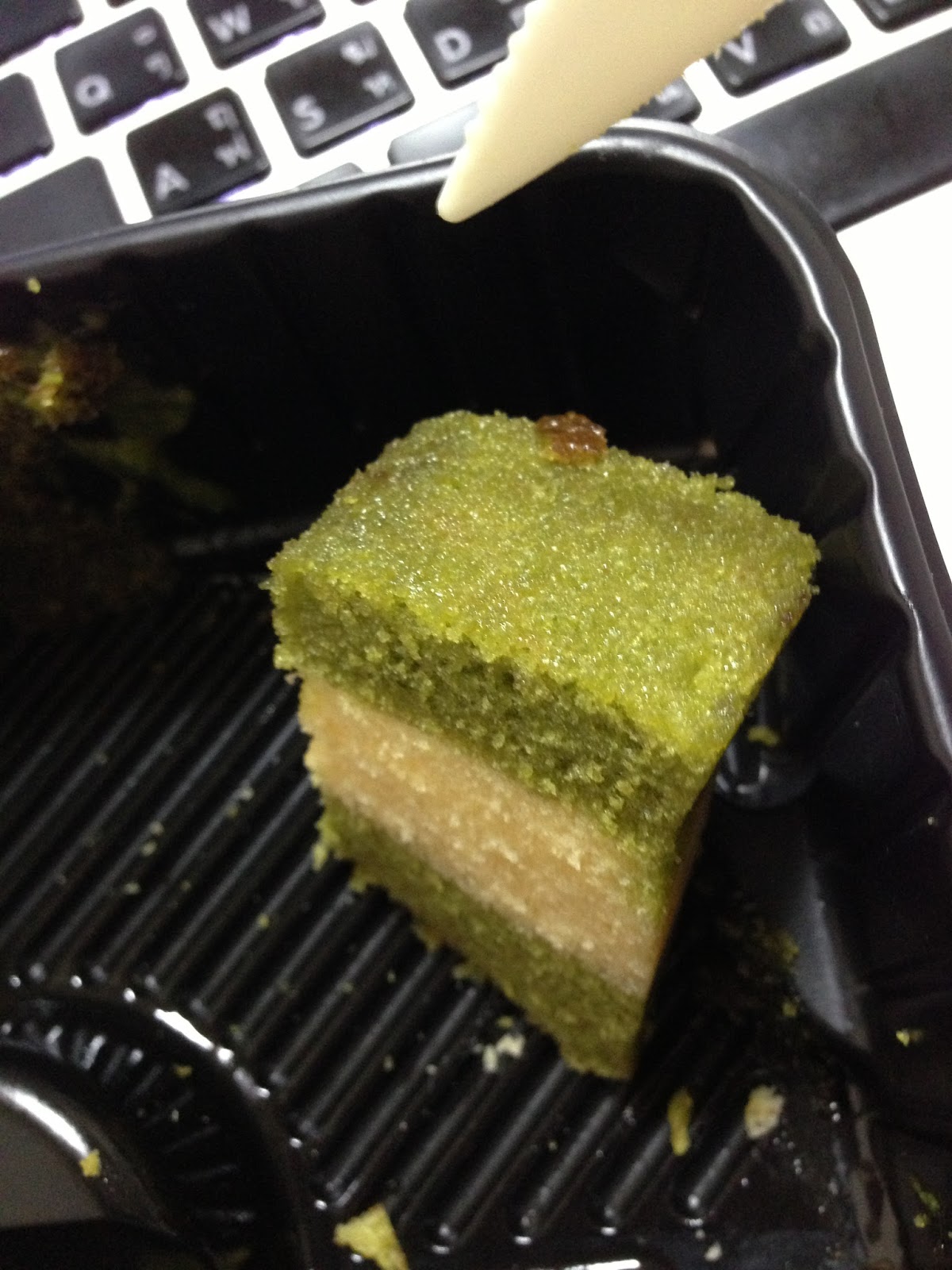
Baumkuchen is a type of cake, which consists of thin layers of cake. Traditionally, Baumkuchen is made on a spit by brushing on even layers of batter and then rotating the spit around a heat source. Baumkuchen is well known around Europe, and is said to originate from a small town in Germany. Now, back to the Kyoubaamu. Kyoubaamu has two distinct sections, green tea section, and soy milk section. Yes, soy milk. I was very surprised after finding out about this certain ingredient. Two years back, I was not able to read Japanese, thus did not have a single clue that this cake was made from soy milk, not from cow's milk. The baumkuchen is also coated with thin coat of sugar syrup. 

As for the taste.. I think that this cake is really good to eat alone, or with other beverages. The cake itself, is not too sweet like others that you can only take a few bites. I ate the whole thing in one go, by myself. You can barely, if ever, taste the soy milk. I think that it is worth a try for all of the matcha (green tea) lovers out there. 

I think Kyoubaamu is available in major stations around Kansai area, as well as many gift shops in Kyoto. Also, here is the link to the official website: http://www.otabe.jp/shop/c/cbaum/


Saturday, April 7, 2012

Maccha Banana (抹茶バナナ)

I've received a box filled with food from a friend's family last week, and this sweet was among many of the delicious ones I've tasted over the week.

The cover didn't tell me much, but the name "maccha banana" did,  the undeniable link between Maccha Banana and Tokyo Banana. I wonder why these sweets aren't named "Kyoto Banana"... Maybe that's because it might be too similar with Tokyo Banana?

Opening the box led me to find six small packages of the Maccha Banana.


As the for actually cake, it is a typical green tea with banana custard fillings cake. When compared with the Tokyo Banana fillings, I feel that the Maccha Banana's fillings are much more subtle than the Tokyo Banana's one. The cake itself is soft, and fluffy, however, the smell of green tea isn't too distinct.

TIPS: I find this cake to be tastier than eaten after a few hours in the refrigerator. The cream somehow tasted tastier when eaten cold.

This is a perfect sweet to be eaten during morning or afternoon tea, or with a hot drink.

The similarity between this and Tokyo Banana of course as I've mentioned above is obvious, however, both of them are also different in a sense that one is a vanilla cake, and the other is a green tea cake. To me, it is impossible to tell you guys which one I liked more, however if asked which one I can consume more, I would certainly still say Tokyo Banana, possibly due to the size.

I couldn't find how much this is on the internet, but I think you can find these in Kyoto Station, and places around Kyoto. I think this is worth a try if you're visiting Kyoto, or worth buying as an お土産 to take home. ;)

Saturday, October 23, 2010

Chanoka (Langues de chat) by Malebranche


Since arriving in Japan, I've become quite a shopper for snacks or sweets. This however, was not originally discovered by me, but indeed, by my parents. They were in Kyoto for a couple of days after sending me off to the beautiful (きれい), but rather quiet (しずかな) town, Beppu.

After a few weeks of talking about the so called 'delicious green tea biscuits' they brought it back home to Thailand with them, I was offered a chance to order the Langues de chat online! (Have I told you how much I love the fact that I own a piece of plastic that is called credit card?? XD)

After the few days of going online, and trying to read all the information on the website that is ONLY in Japanese, I've come to a conclusion that I needed help. I went to a senpai (senior student), and asked him to translate and place an order. Funnily enough, he taught me a valuable lesson, and that is, 'google translation' can save your life. I mean, the thing can translate almost anything. Of course, there are times that the translation piece makes no sense at all, but most of the time, you can understand what it is trying to tell you.

Langues de chat are classic French butter cookies. You often see them beside ice-cream in restaurants. They are sometimes known as 'Cat's Tongues' because of its' oval shape.

A box of 茶の果 (Chanoka) [30 pcs] at a price of ¥3,780, with an extra ¥427 for shipping. However, the product also comes in 5, 10, 16 (comes in a beautiful metal box, which my friends have convinced me that it won't be much use after I've eaten all the biscuits), and 20 pieces.

After you purchase the product, you will get one confirmation email, that order has been sent to the company. After a few days or so, you will receive the 2nd email that contains the shipping code, so that you can check online about your purchase's whereabout.

Not even a week after I've ordered Chanoka, the product was delivered to me, refrigerated.

Here's the package.


Now, onto the inside of the package. 


In a way, 茶の果  is two pieces of thin green tea biscuits with white chocolate between them. On your first bite, you may be shock by how strong the green tea flavor is, without realizing the smoothness of the white chocolate. However, on your second bite, you would be able to feel the richness of the chocolate that is well balanced by the green tea biscuits. 


There is a bit of an aftertaste of the green tea itself, but overall, I thought it was worth every ¥127 for each pieces of Chanoka!

TIPS: Before eating, if it has been stored in the fridge, put it outside for awhile before eating, as it makes the chocolate soften, and personally, I find that it's taster when you eat it when it's not so hard, and cold.

Whenever I have the chance to travel around Japan, I definitely would make a pit stop in Kyoto to visit Malebranche, and try other famous sweets!

For those who are interested in Chanoka or Malebranche, please visit their site.